Scaling AI Reception Across Multiple Clinic Locations: One System, Many Numbers
Deploying separate AI agents for every clinic location creates a maintenance nightmare. Here is how to architect a single, multi-tenant voice AI system that handles dozens of phone numbers dynamically.
When a clinic network expands its AI automation to a second, fifth, or twentieth location, the architecture usually breaks. A common anti-pattern when scaling is to treat AI receptionists like human hires: spinning up a new, isolated AI agent for the new clinic, assigning it a local phone number, and hardcoding its prompt with that specific clinic’s address, doctors, and operating hours.
This creates AI spaghetti. For a 10-location network, this translates to 10x the deployment risk and hundreds of wasted engineering hours annually. A network with twelve locations ends up maintaining twelve separate codebases, twelve isolated connection pools to the Electronic Medical Record (EMR) system, and twelve different versions of compliance guardrails. When a new data privacy regulation takes effect, or when a new triage protocol for pediatric calls is introduced, IT teams must update and test twelve different systems. The resulting maintenance debt quickly erases the cost savings of automation.
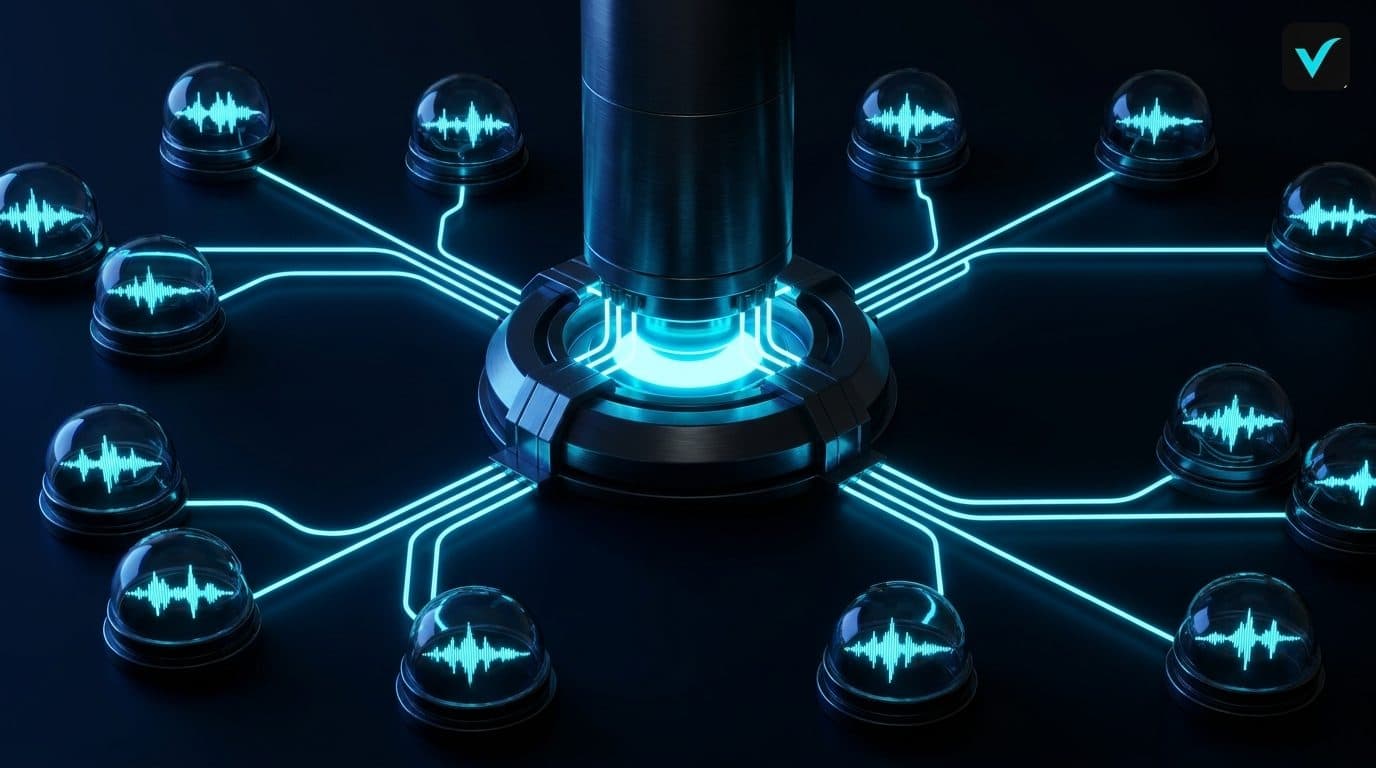
Production-grade AI systems do not scale by duplicating agents. They scale through multi-tenancy. A single, centralized voice AI engine can handle hundreds of concurrent calls across dozens of phone numbers by dynamically loading the correct clinic’s context the millisecond a call connects.
Here is how to architect a multi-location voice AI system that reduces maintenance to a single codebase, cuts infrastructure costs, and enables cross-clinic appointment booking.
The Mechanics of Dynamic Call Routing
From a business perspective, hardcoding location data into separate AI models is a major financial risk. It requires paying developer rates ($100+/hour) for simple text updates. Dynamic call routing eliminates this overhead entirely by separating the technical core from local business data, ensuring that expanding your network does not linearly scale your engineering bills.
The foundation of a multi-location AI receptionist is Direct Inward Dialing (DID) routing. When a patient dials a local clinic number, the call is routed through a SIP trunk (like Twilio or a local telecom provider). The webhook payload that triggers the AI system contains the To number.
Instead of routing that payload to an isolated agent, the centralized system uses the To number as a primary key to query a configuration database. Within milliseconds, the system retrieves the location's specific metadata:
</>View technical implementation · عرض التفاصيل التقنية
{
  "did_number": "+97145550199",
  "location_id": "loc_dubai_marina",
  "clinic_name": "Marina Specialty Center",
  "emr_tenant_id": "t_88349",
  "operating_hours": "08:00-20:00",
  "active_physicians": ["Dr. Al-Farsi (Cardiology)", "Dr. Chen (Pediatrics)"],
  "parking_instructions": "Level B2, validate ticket at reception",
  "fallback_human_queue": "sip:marina_frontdesk@network.com"
}
This JSON object is injected directly into the system prompt of the Large Language Model (LLM) before it generates its first greeting. The AI does not need to be fine-tuned on the Marina clinic’s details, nor does it need a dedicated RAG (Retrieval-Augmented Generation) vector store just for basic location facts. The context is injected dynamically into the LLM's working memory for the duration of the call.
This architectural choice has immediate business consequences. When the Marina clinic changes its operating hours for Ramadan, an operations manager updates a single field in a standard SQL database. The next call that comes in instantly reflects the new hours. No code changes, no prompt engineering, and no deployment pipelines are required.
Pooling EMR Connections and Latency Budgets
Voice AI lives or dies by latency. In human conversation, a pause longer than 500 milliseconds feels unnatural; anything over 1,000 milliseconds causes callers to interrupt the AI or hang up. High latency isn't just a technical metric; it is a direct driver of patient drop-off. Every 100ms of delay beyond the human threshold increases call abandonment rates by up to 3%, directly risking booked appointments.
When an AI receptionist needs to check a doctor's availability, it must query the EMR system (via HL7 FHIR or a REST API). If you run isolated AI agents for each location, each agent typically initiates a cold connection to the EMR API when a call comes in. In legacy EMR systems, establishing this connection and authenticating can take 300 to 600 milliseconds - consuming your entire latency budget before the LLM has even generated a response.
A centralized architecture solves this by maintaining a warm, multiplexed connection pool to the EMR. Because all locations route through a single backend service, the system can hold open authenticated sessions with the EMR. When the AI requests Dr. Chen's schedule, the API call can execute in as little as 50–150 milliseconds, protecting your conversion rates.
To achieve sub-500ms latency across a multi-location network, the pipeline must be strictly optimized:
- ▸Streaming Speech-to-Text (STT): Using models like Deepgram Nova-3 via WebSockets to transcribe audio as the user speaks, rather than waiting for them to stop.
- ▸Predictive Tool Calling: Structuring the LLM orchestration (often via LangGraph) so that the system begins querying the EMR the moment it detects intent, rather than waiting for the full sentence to complete.
- ▸Streaming Text-to-Speech (TTS): Using low-latency TTS endpoints that begin synthesizing audio the moment the LLM outputs its first comma or period.
For enterprise healthcare brands looking to deploy these latency-optimized pipelines without rebuilding their integration framework from scratch, reviewing pre-architected voice infrastructure is the logical next step.
Cross-Booking: The Revenue Advantage of Centralization
The most significant business advantage of a centralized AI architecture is cross-booking, which directly impacts top-line revenue.
Consider a standard patient journey: A patient calls the Downtown clinic requesting an urgent appointment with a dermatologist. The Downtown clinic is fully booked for the next four days. If the Downtown clinic is running an isolated AI agent, the conversation ends with the AI apologizing and offering an appointment next week. The patient hangs up and calls a competitor.
For a standard multi-location clinic, patient leakage (callers who hang up because their preferred slot is taken) averages 15–20%. By enabling cross-booking, networks can recapture up to 35% of these lost leads. This translates to an estimated $12,000 to $45,000 in recovered monthly revenue per 10-clinic cluster, depending on average patient lifetime value (LTV).
A multi-tenant AI system has global visibility across the network. Because the AI's state management graph is connected to the central EMR pool, it can execute a broader search. The logic flow operates like this:
- ▸Check requested location (Downtown) for Dermatology availability today. Result: Null.
- ▸Query database for nearby locations within a 10km radius offering Dermatology. Result: Uptown clinic.
- ▸Check Uptown clinic for Dermatology availability today. Result: 14:30 available.
- ▸AI response: "I don't have any openings at our Downtown clinic today, but Dr. Hassan at our Uptown clinic - which is about 15 minutes away - has an opening at 2:30 PM. Would you like me to book that for you?"
This capability protects revenue that would otherwise be lost to patient attrition. Implementing this in a fragmented, isolated-agent architecture requires building complex peer-to-peer communication between different AI instances. In a centralized system, it is simply a matter of granting the tool-calling function access to array parameters (e.g., location_ids: ["loc_downtown", "loc_uptown"]).
The Economics of Scale: Centralized vs. Isolated
When evaluating the cost of AI reception, decision makers often focus entirely on the per-minute API costs. However, the true cost of operating these systems at scale is driven by infrastructure redundancy and maintenance overhead.
Let us evaluate the variable API costs of a standard voice AI pipeline per minute (illustrative based on standard 2026 API rates):
- ▸Telephony (Twilio SIP): ~$0.004 / min
- ▸Speech-to-Text: ~$0.0043 / min
- ▸LLM Inference (Fast tier): ~$0.0015 / min (Assuming ~200 tokens per minute)
- ▸Text-to-Speech: ~$0.060 / min
- ▸Total Variable Cost: ~$0.07 per minute of active conversation.
For a network of 10 clinics, each handling 100 calls a day at an average of 3 minutes per call, the total network volume is 3,000 minutes per day. The variable API cost is identical regardless of architecture: roughly $210 per day, or $6,300 per month.
The financial divergence happens in fixed costs, compliance risks, and engineering maintenance.
| Cost Component | Isolated Architecture (10 Instances) | Centralized Architecture (1 Multi-Tenant) |
|---|---|---|
| Variable API Costs | ~$6,300 / month | ~$6,300 / month |
| Server Infrastructure | 10x container deployments | 1x auto-scaling cluster |
| EMR Integration | 10x API gateway configurations | 1x unified API gateway |
| Prompt Updates | Manual updates across 10 codebases | 1x database update (instant across network) |
| Analytics & Reporting | Fragmented; requires data aggregation | Unified; native global dashboards |
The isolated architecture requires an engineering team to manage ten separate deployment pipelines. The real financial risk of this approach is the operational bottleneck. A single compliance update (such as US HIPAA adjustments or UAE PDPL compliance) across 10 isolated instances can take up to 40 engineering hours of deployment and testing - costing thousands of dollars and leaving the network temporarily exposed to compliance fines.
The centralized architecture requires a higher initial engineering investment to build the multi-tenant routing logic, but adding the 11th, 12th, or 50th location requires minimal additional infrastructure configuration, bringing the marginal cost of scaling new locations down to near zero.
Managing State and Hallucination Risks
In healthcare, an AI hallucination is not just a software bug; it is a liability risk. If an AI books a patient under the wrong clinic ID, it can lead to compliance violations, scheduling chaos, and severe reputational damage. Deterministic state orchestration acts as an automated insurance policy against these errors.
Scaling a single AI system across multiple locations introduces a specific technical risk: context contamination. If a caller is speaking with the AI about the Downtown clinic, the AI must not hallucinate and provide the parking instructions for the Uptown clinic, nor should it accidentally book the patient into the wrong EMR tenant.
This is managed through deterministic state orchestration. We do not rely on the LLM to "remember" which clinic it is representing based purely on the conversation history. Instead, the orchestration framework (such as LangGraph) maintains a strict state object for the duration of the call.
When the LLM decides it needs to call the book_appointment function, the orchestration layer intercepts that request. The LLM is not allowed to specify the tenant_id. The orchestration layer automatically injects the tenant_id from the secure state object (derived from the initial DID routing) before passing the API request to the EMR.
By removing the LLM's ability to choose the tenant ID, you structurally eliminate the possibility of the AI booking a patient at the wrong clinic due to a hallucination. The LLM handles the unstructured conversation; the deterministic code handles the structured data execution. This separation of concerns is what distinguishes a production-grade AI system from a fragile proof-of-concept.
Frequently Asked Questions
Q: What is the typical ROI and payback period for migrating to a centralized voice AI system?
Most clinic networks see a full return on investment (ROI) within 3 to 6 months of deployment. By reducing front-desk administrative burdens by up to 40%, recapturing lost revenue through cross-booking, and eliminating redundant maintenance hours, a 10-location network typically saves $15,000 to $25,000 per month in operational costs while simultaneously increasing booking volumes.
Q: How does a centralized system handle different local languages or dialects across regions?
The routing database stores language preferences per location. If a DID number belongs to a clinic in Riyadh, the system injects instructions to prioritize Saudi Arabic dialects and adjusts the Speech-to-Text model parameters accordingly. If the number belongs to a clinic in Dubai, it can default to English or Gulf Arabic based on the specific neighborhood demographics, all handled dynamically by the same core engine.
Q: What happens if the central server goes down? Do all clinics lose their phones?
Production systems utilize fallback routing at the SIP trunk level. If Twilio attempts to send a webhook to the central AI server and receives a 5xx error or a timeout, the SIP trunk is configured to instantly route the call to a physical hunt group (human receptionists) or a traditional IVR backup. No call is ever dropped due to an AI server failure.
Q: Can a centralized AI system route difficult calls to local human staff at the specific clinic?
Yes. Because the system knows the exact location context of the call, its transfer_to_human tool is dynamically populated with the SIP address of that specific clinic's front desk. If a patient asks for a human, the AI executes a warm transfer directly to the local staff, not a global call center.
Q: Does implementing this architecture require changing our existing VoIP provider?
Usually not. As long as your current telephony provider supports SIP forwarding or webhooks for incoming calls, the AI system can be integrated as a node in your existing network. The provider simply forwards the specific clinic numbers to the AI system's SIP URI, allowing you to maintain your current telecom contracts and numbers.