What an Audit Trail for AI Decisions Looks Like: Logging the Reasoning, Not Just the Outcome
A useful AI audit trail records why each decision was made: the inputs, the rules that fired, the evidence used and who approved it. Here is the record structure, what the model's own explanation is worth, and what keeping it costs.
An audit trail for AI decisions has one record per routing or messaging decision. It shows what the system saw, which rules applied and what evidence it used. It also shows what the model proposed, which checks it passed and who signed off. A log line saying "email routed to Sarah at 09:14" proves something happened. It cannot prove the decision was allowed. That gap becomes your problem when a compliance officer, regulator or customer's lawyer asks why.
Why isn't a timestamp and an outcome enough?
Compliance teams used to ask whether a message went out. Now they ask why the system picked that advisor, that wording, that priority. The question has moved from "what" to "on what basis."
Regulatory text points the same way. Under Article 15 of the GDPR, people have a right to "meaningful information about the logic involved" in automated decisions covered by Article 22. Under Article 12 of the EU AI Act, high-risk AI systems must keep logs over their lifetime so they can be examined later. Not every routing system falls under either provision. Where one does apply, a row with a status and a time will not satisfy it.
Infrastructure logs do not close the gap either. Amazon Bedrock, for example, is integrated with AWS CloudTrail. CloudTrail records each API call: who made it, from which IP address, and when. That matters for security. It tells you the model was called. It cannot tell you which of your business rules decided the outcome, because those rules live in your application, not in the provider's API.
So a disputed decision stops being a lookup. It turns into an engineering investigation across application logs, provider logs and someone's memory of which prompt was live that week.
What goes into one decision record?
This is the structure we use as a starting point. Each field exists because someone, eventually, will ask the question in the right-hand column.
| Field | What it holds | The question it answers |
|---|---|---|
| Decision ID and time | Unique ID, timestamp, channel (email, voice, form) | Which decision are we talking about? |
| Input snapshot | The message as received, or a hash plus a pointer to the stored copy | What did the system actually see? |
| Extracted facts | Intent, named entities, risk flags the model pulled out | What did the system think the message said? |
| Rules evaluated | Each rule ID and version checked, pass or fail, and the values it tested | Which policy produced this outcome? |
| Evidence used | IDs and versions of documents or templates used to draft a reply | Where did the content come from? |
| Model proposal and stated rationale | The action the model suggested and its short explanation | What did the model recommend, and what did it claim as its reason? |
| Gate results | Each compliance check run on outbound text, and whether it passed or blocked | Was customer-facing text checked before it went out? |
| Human actions | Reviewer ID, approve, edit or reject, and the edit diff | Who took responsibility, and what did they change? |
| Versions | Model identifier, prompt version, rule set version, code commit | Could we reproduce this decision today? |
| Final outcome | What was sent or routed, to whom, and delivery status | What did the customer actually receive? |
Most systems already capture the first and last rows. The row most systems are missing is "rules evaluated." That gap is usually a design choice rather than a logging oversight. If your routing policy lives inside a prompt, there is no rule ID to log. The model's output is the policy, and the policy is invisible. Moving rules into code or configuration fixes both the logging problem and the consistency problem in one move.
Can you trust the model's explanation of its own decision?
Only partly, and this is where many audit designs go wrong.
A language model's stated rationale is generated text, like the rest of its output. Published research on model reasoning has found that stated explanations do not always match what actually drove the output. Logging the model's "thinking" feels like logging the reasoning. It is closer to logging the model's account of its reasoning.
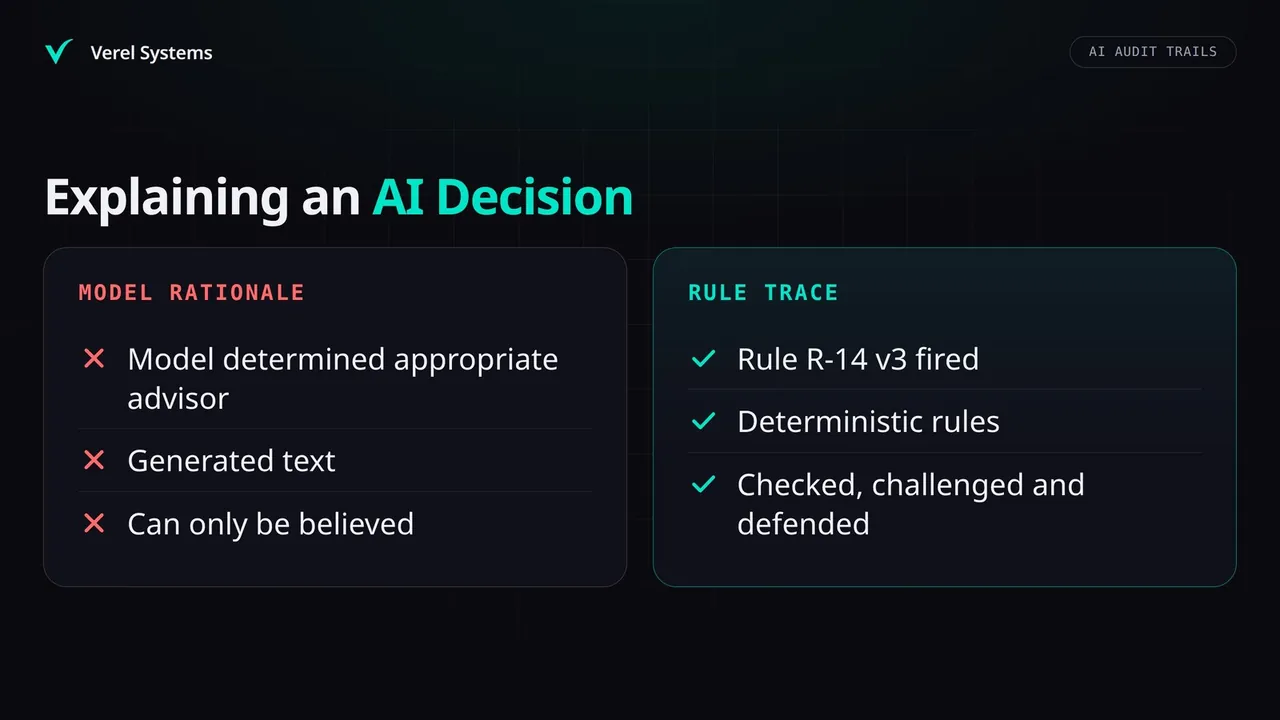
The design that holds up under examination splits the work. The model reads the message, extracts facts and proposes an action. Deterministic rules, written and owned by your compliance or operations team, decide what is permitted. The explanation of record then becomes the rule trace. Rules can be replayed: same inputs, same rule version, same outcome.
Compare two entries a reviewer might read six months later:
- ▸"Routed to licensed advisor. Rule R-14 v3 fired: message references an investment product and sender is an existing client."
- ▸"The model determined this was the most appropriate advisor."
The first can be checked, challenged and defended. The second can only be believed. Keep the model's rationale in the record, clearly labeled as the model's statement, because it helps reviewers spot extraction errors. Just don't let it carry the legal weight.
What makes the record hold up when someone examines it?
A record that exists is not the same as a record that persuades. Five properties separate the two.
Written at decision time, never reconstructed. The record is written in the same step as the action. If the record fails to write, the action does not proceed. A trail assembled afterwards from other logs is a reconstruction, and anyone examining it will treat it as one.
Append-only and tamper-evident. Records go to write-once storage, where nothing can be edited or deleted before the retention period ends. Each record can also carry a hash of the previous one. Altering any entry then breaks the chain visibly.
Versions pinned by reference. Prompts, rule sets and templates live in a versioned registry. The record stores the version ID, so "which prompt was live on 3 March" has a one-line answer.
Personal data held separately. Retention duties and erasure rights pull in opposite directions. The workable pattern stores message content and personal data in a separate store, referenced by ID. You can then redact or delete personal data without breaking the integrity of the decision chain.
Readable by the people who ask. Compliance should be able to pull a case by customer, date or decision ID without filing a ticket with engineering. If every audit request needs a developer, the trail exists on paper only.
If you are working toward ISO/IEC 42001, the 2023 standard for AI management systems, these records are the operating evidence an auditor will want to sample. A policy document says what should happen. Decision records show what did.
Isn't this what AI observability tools already do?
No. The two overlap, but they answer different questions. Gartner predicted in May 2026 that 40 percent of organizations deploying AI will use dedicated AI observability tools by 2028. Those tools track performance, bias and outputs across many requests. They tell you the system is drifting.
An audit trail answers a narrower question about one case: was this specific decision permitted, and who is accountable for it? Tracing tools such as Langfuse capture prompts, model calls and latency well. They will not know your rule IDs or your reviewer sign-offs unless you design those in. Most regulated teams need both, and should not assume one covers the other.
What does keeping all this cost?
Less than people expect for storage. More than people expect for design. Here is an illustrative storage calculation:
Annual storage = decisions per day × record size × 365
- ▸Mid-sized team: 2,000 decisions/day × 20 KB = 40 MB/day, or about 14.6 GB per year.
- ▸At standard object storage prices of roughly $0.02 to $0.03 per GB-month, that is under $0.50 a month.
- ▸Push both volume and record size up tenfold: 20,000 × 200 KB = 4 GB/day, about 1,460 GB per year.
- ▸That costs roughly $29 to $44 a month (1,460 × $0.02 and 1,460 × $0.03).
Check your provider's current price sheet, but the order of magnitude will not change. Storage is not the constraint.
The real cost is structural. You have to give rules IDs, version your prompts, build the compliance gate and build a review screen. That work is cheap to include at build time. Retrofitting it means touching every decision path in a running system, which is why the trail belongs in the first specification, not the second.
How do you test whether your current system has a real trail?
Run one exercise. Pick a customer-facing decision your AI system made three months ago, then ask whoever runs it to show you, within ten minutes:
- ▸The exact message the system received.
- ▸Every rule it checked, with the version in force that day.
- ▸The outbound text, and which compliance checks it passed.
- ▸The person who approved it, if anyone did, and what they changed.
- ▸Enough version detail to re-run the decision today and get the same routing.
If any item takes an engineer and an afternoon, you have logs, not an audit trail. That is a fixable state. It just needs fixing before the first formal request, not after.
This is the problem Verel Coordinator is built around. It routes inbound work under your own rules and enforces a compliance gate on anything that reaches a customer. It flags suspicious messages for human review and logs every decision with its reasoning. Like every Verel build, it is fixed price, agreed in writing, with full source code handed over.
→ Encoding Business Rules Outside the Prompt: Weighted Rotation, Ownership, and Exceptions → AI Lead Routing in Regulated Firms: Who May Say What to a Prospect, Enforced by the System → Agent Evals in Production: Tracing Tool Use and TrajectoriesFAQ
Do we need to store the full text of every message? Not always. Many teams store a hash in the decision record and keep the content in a separate store under its own retention policy. The hash proves the content has not changed. Set the retention period from your legal obligations, not from storage cost.
Can we add an audit trail to an AI system we already run? Yes, but the order matters. If your routing logic lives inside prompts, extract it into versioned rules first. Logging comes after that. Adding logging to prompt-embedded logic gives you a detailed record of decisions you still cannot explain.
Is logging the model's chain of thought enough for compliance? No. A model's stated reasoning is useful context for reviewers, but it is not a reliable account of what drove the output. The explanation of record should be the deterministic rule trace, with the model's rationale stored beside it and labeled as the model's own statement.